The entangled fate of the Usher family and mansion
The Fall of the House of UsherThe entangled fate of the Usher family and mansion is central to the story’s Gothic design: inheritance binds the family to its ancestral property, Roderick Usher imagines the house as an influence upon his mind and destiny, and the deaths of Roderick and Madeline Usher coincide with the mansion’s collapse. The narrative leaves the force of that connection uncertain, balancing Roderick’s conviction against the narrator’s more cautious observations.
Name, Lineage, and Estate
The Usher family is described as ancient and marked across generations by an unusual sensibility, expressed in exalted art, discreet generosity, and a passionate interest in the intricacies of music. Its line has produced no enduring collateral branch: the family’s inheritance has passed along a direct line, with only brief and minor variation. The narrator considers this continuity a reason the family and its estate have become so closely identified.
That identification is embedded in the name House of Usher. It refers not only to the family but also to the family mansion, so that the name of the estate has come to encompass its owners. The uninterrupted passage of the patrimony with the family name makes the property more than a setting: it is the material counterpart of a lineage whose identity has remained concentrated in one house and one line of descent.
The Mansion as an Influence
Roderick regards the mansion’s form and substance as having acquired power over his spirit. He has not ventured outside for many years, and describes the influence of the gray walls, turrets, and tarn as an effect that prolonged habitation has impressed upon his life. He calls his nervous disorder a constitutional and family affliction, but also believes the dwelling contributes to the condition that confines him.
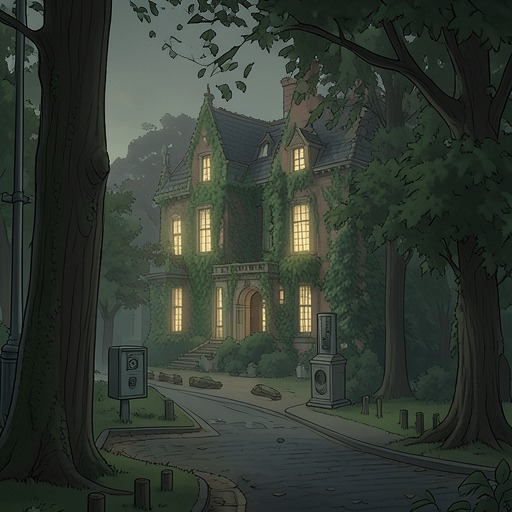
The narrator’s first impressions offer a more guarded parallel. Looking at the house and its reflection in the tarn, he imagines a peculiar atmosphere rising from the decayed trees, gray walls, and still water. He recognizes that his growing superstition may be intensifying his response; the atmosphere is presented as a powerful impression, not proof that the house possesses an independent will.
Roderick develops the connection into a theory of sentience. After the two men consider The Haunted Palace, he argues that life might extend beyond the vegetable world under particular conditions. In his account, the stones’ arrangement, the fungi covering them, the decayed trees nearby, the long persistence of the whole, and its reflection in the tarn combine to produce an atmosphere of the mansion’s own. He sees this atmosphere as evidence of a silent influence that has shaped his family’s destiny and made him what he is. The narrator reports the belief without confirming it, preserving the uncertainty between supernatural agency and Roderick’s disordered interpretation.
Kinship, Illness, and Confinement
The family’s fate is also concentrated in the relationship between Roderick and his sister, Madeline, his sole companion for many years and his last surviving relative. He associates her approaching death with the possibility that he will become the final member of the ancient family. Her illness has baffled her physicians and includes wasting, apathy, and recurring, temporary cataleptic episodes. When Roderick reports that she has died, he chooses to keep her body for a fortnight in a vault within the mansion before its intended burial, citing the unusual illness, the physicians’ inquiries, and the burial ground’s remote and exposed location.
The narrator helps Roderick carry her coffin to a small, damp, lightless vault deep beneath the portion of the house where the narrator sleeps. This placement makes the family’s crisis literal within the mansion: Madeline is kept inside its walls, while Roderick remains above, surrounded by the building he believes has shaped his life. Later, as the narrator reads The Mad Trist, sounds from within the house appear to echo the story. Roderick finally reveals that he heard movements from the coffin days earlier but dared not speak, and understands the sounds as Madeline struggling within the vault. His confession turns the house’s enclosed spaces into the setting of a family catastrophe, without resolving how much of the earlier sound and terror the narrator or Roderick interpreted correctly.
Shared Destruction
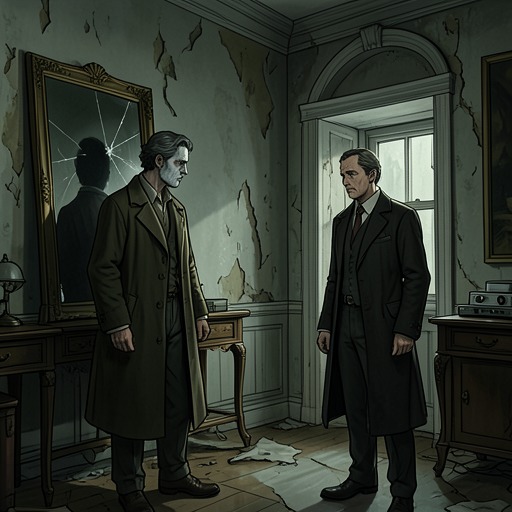
Madeline returns to the chamber and falls upon Roderick; both die. Her return confirms that she had been entombed before her death, while Roderick’s death fulfills the consequence he feared: with his sister gone, he had described himself as the last of the line. The narrator then flees the mansion into the storm.
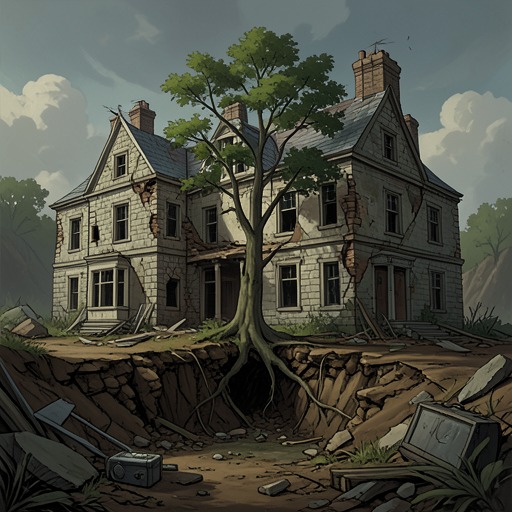
From the old causeway, he sees the fissure that had extended from the roof toward the base widen as the blood-red moon appears behind the house. The walls rush apart, and the tarn closes over the fragments of the House of Usher. The ending gives the family and mansion a common terminal moment: the last Usher siblings die, the ancestral house is destroyed, and the name that joined family to estate loses both its living line and its physical home. The sequence powerfully echoes Roderick’s belief in their mutual fate, while the narrative’s restraint leaves the house’s supposed agency unresolved.